Home › Guides › Porcelain patios: 5 things that catch people out
Never done this before? Start here
Porcelain is a man-made slab, baked hard in a kiln — think of a very tough outdoor version of a kitchen floor tile.
Natural stone (like Indian sandstone) is real rock, cut into slabs.
Whichever you pick, the slabs sit on the same groundwork — a layer of packed stone with a wet sand-and-cement mix on top — and that groundwork is where most of the money goes.
1. Porcelain quietly stopped being the expensive option
For years porcelain was the upgrade you talked yourself out of. Not any more. Cheap outdoor porcelain now starts around the same price as Indian sandstone. Factories have got better at making it, so prices have dropped — while natural stone has stayed put. If the last time you priced a patio was 2021, your figure for porcelain is out of date.
On our own checked 2026 prices, a patio laid by a professional runs £75–£125/m² in budget concrete, £85–£155/m² in Indian sandstone and £100–£180/m² in porcelain — materials plus £45–£70/m² of labour. The UK average lands near £130/m² fitted — our patio calculator prices all three for your exact size. Notice how much those ranges overlap. That is the real story: a good porcelain job and a good sandstone job cost roughly the same money.
2. It genuinely does need almost nothing doing to it
This is where porcelain earns its keep — not for its looks, but for how little care it needs. Porcelain is baked at such a high heat that it comes out almost completely non-porous (it cannot soak anything up). Red wine, barbecue fat and algae sit on top instead of sinking in, the way they do with stone. Frost doesn't hurt it. And — the big one — it never needs sealing (sealing means painting on a protective coat to stop stains soaking in).
Natural stone usually wants resealing every couple of years, plus the odd repair to the joints between slabs. Over ten years that is several lost weekends and a few hundred pounds of sealant. Porcelain asks for a brush and a wash.
3. DIY is exactly where the budget explodes
The showrooms are quiet about this, and it is the single most expensive thing to get wrong. Porcelain is dense and brittle. You cannot score it and snap it like some slabs — clean cuts need a wet saw (a power saw with a diamond-tipped blade, cooled by water). Each slab has to sit on a full bed of mortar (wet sand-and-cement mix) covering the whole underside — not five blobs in the corners. And every slab needs slurry primer painted onto its back before it goes down. Slurry primer is a glue-like paste, and it is the only thing that makes mortar stick to a tile that cannot soak anything up.
Skip the primer and the slabs work loose within a season or two. Usually one corner starts to sound hollow underfoot, then the slab rocks. Force a cut and you crack a £40 tile. The saving from doing it yourself vanishes fast — and putting it right means lifting the slabs and laying them again.
If you take one thing from this article: no primer, no bond. It's the step that separates a twenty-year patio from a two-year one.
4. The slab price is the small number
The slabs themselves are a small share of the total. Most of the money goes on digging out the ground, the sub-base (the layer of packed stone underneath), the mortar, the cutting, the waste and the labour — and those cost about the same whichever slab you choose. That is why moving up from budget concrete to porcelain costs far less than the slab prices suggest: you are paying for the same groundwork either way.
A worked 25m² example on our checked prices lands somewhere around £1,500–£4,500 all-in, depending on which slab you pick and how easy your garden is to get into. The base and the labour take most of it. Ask every quote to list the digging out, the sub-base depth, the mortar bed and the rubbish removal as separate lines. A quote that is cheap because it skips the sub-base is not a cheap quote; it is a future repair.
5. Order samples — porcelain lies under showroom lights
Stone-effect and wood-effect porcelain are printed patterns, and the photos of them are lit to flatter. UK daylight is flat, grey and unkind for eight months of the year. A warm beige that looked lovely under bright shop lights can look plain pink on a wet Tuesday in November.
Every decent supplier will send samples. Put them on the actual spot. Look at them wet as well as dry, and in the morning and the evening. It costs nothing, and it is the difference between a patio you like and a patio you put up with.
What we'd actually buy
Prices checked July 2026
Some links below are affiliate links — we may earn a commission, at no cost to you.
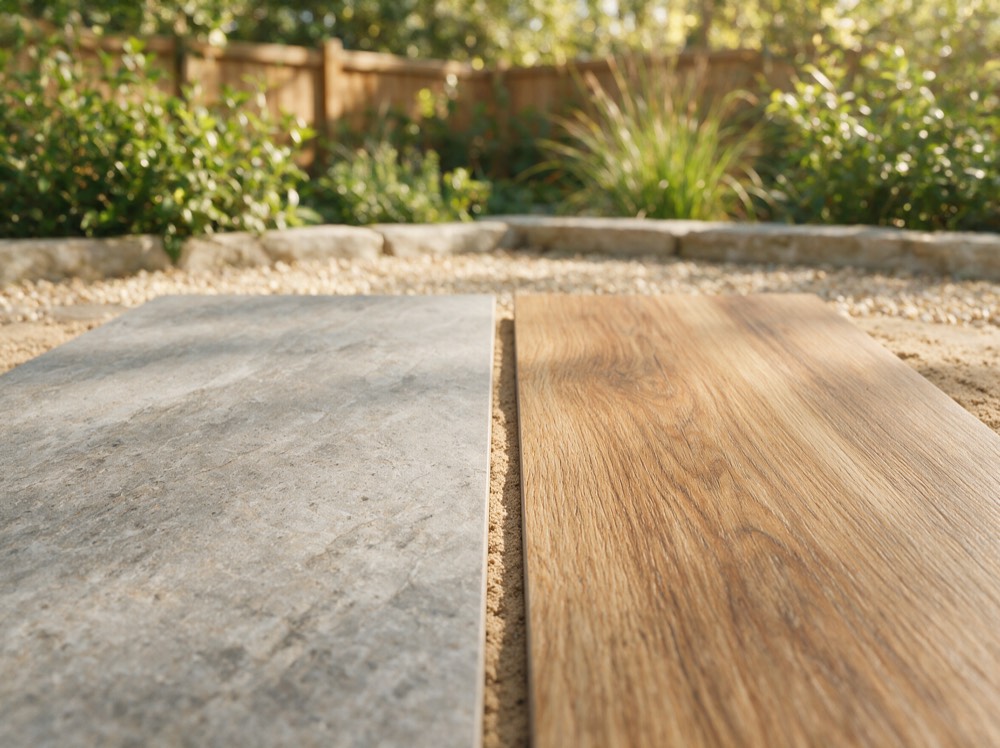

20mm calibrated outdoor porcelain
Budget ranges from about £20–£30/m²
The spec that matters is 20mm and calibrated, outdoor grade, R11 slip rating. Calibrated means every slab is exactly the same thickness — that is what makes a flat patio possible. R11 is a grip rating; it means the surface is textured enough not to be slippery when wet. Thinner tiles are for indoor floors only and will not survive a frost or a wheelbarrow. Very big slabs look expensive, but they are heavy to handle and show up any bumps in the base — 600×600mm is the sweet spot for most gardens. Order samples before you commit to a full load.
Compare outdoor porcelain on Amazon →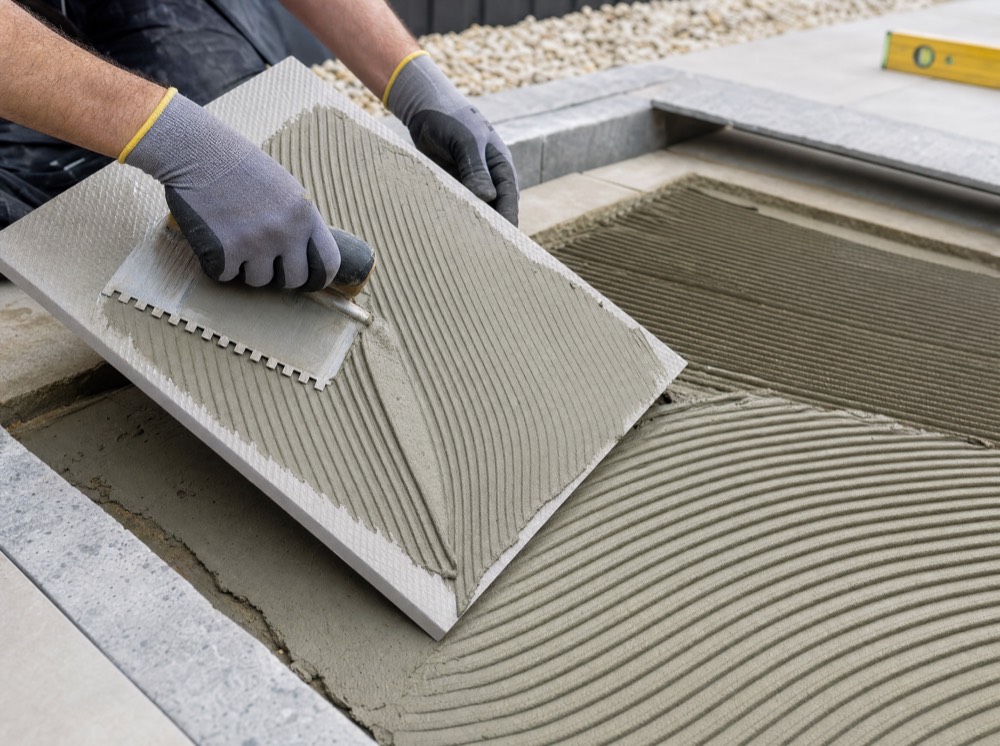
Slurry primer — the step you cannot skip
About £25–£45 a tub
The most important £30 in the whole job. Slurry primer (sometimes sold as SBR slurry bond) is a glue-like paste you paint onto the back of every slab just before it goes down. It is the only thing that makes mortar stick to a tile that cannot soak anything up. There is no workaround, no “the mortar is strong enough”, no skipping it on the slabs nobody walks on. One tub covers a typical small patio.
Slurry primer on Amazon →
Hire the wet saw, don't buy one
Around £40–£70 for a weekend
You need a wet saw with a diamond blade made for porcelain to get clean cuts — but only for two or three days, not for life. Hiring costs a fraction of buying, and hire machines are bigger and better than the cheap ones you would buy. One tip: buy your own blade even when you hire the saw. A worn-out hire blade is what chips expensive tiles.
Wet saw hire at HSS →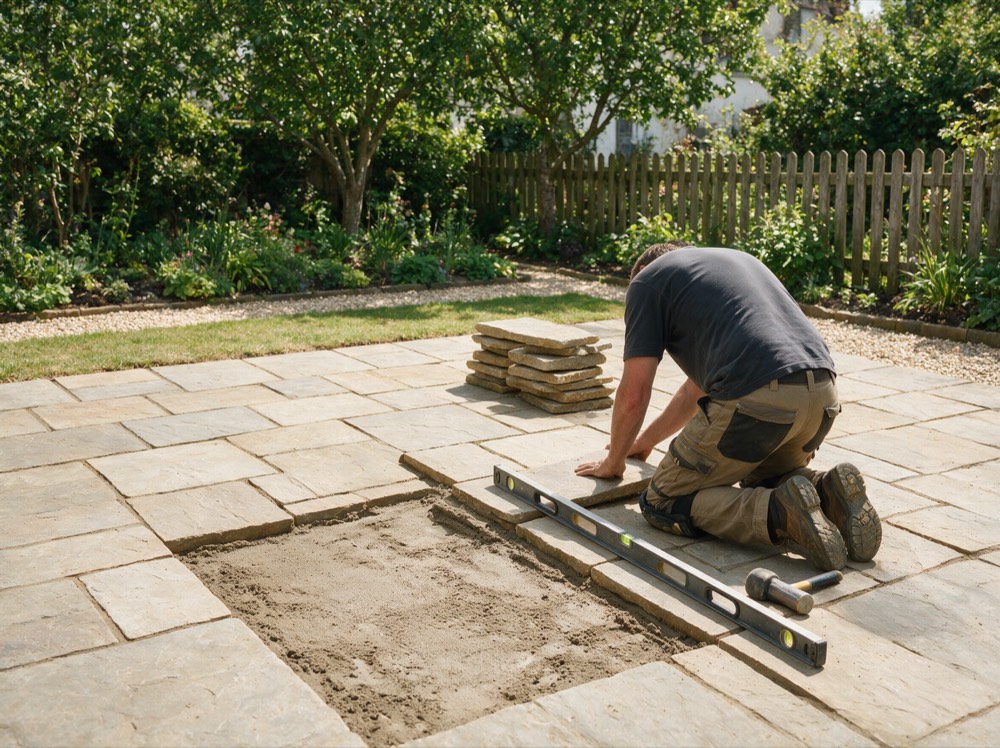
Rather not do it yourself?
Porcelain is the least forgiving patio material there is. A full mortar bed, primed slab backs and clean saw cuts are skilled work, and mistakes get expensive fast. Post the job free and local landscapers reply with quotes, so you can compare real prices against our estimate.
Find a tradesperson for this project → patio calculator
Get my answer — free →
patio calculator
Get my answer — free →
Read next
Is porcelain paving expensive?
Not any more. Budget outdoor porcelain now starts around the price of Indian sandstone. The groundwork costs the same whichever slab you choose, so moving up to porcelain costs far less than the slab prices suggest. Fitted, expect roughly £80–£180/m² on our 2026 checked prices.
Can I lay porcelain paving myself?
You can, but it is the hardest patio material to lay yourself. It needs a full bed of mortar (wet sand-and-cement mix), slurry primer painted on the back of every slab, and a wet saw for cuts. Skip the primer and the slabs work loose. The saving from doing it yourself disappears on the first cracked tile.
Does porcelain paving need sealing?
No. Porcelain cannot soak anything up, so unlike natural stone it never needs sealing — just brushing and washing.
What thickness of porcelain do I need outside?
20mm, calibrated (all slabs exactly the same thickness), outdoor grade. Thinner tiles are for indoor floors and will not take frost or heavy weights on a small spot.
Is porcelain slippery when wet?
Outdoor porcelain is made with a textured surface and is usually rated R11 for grip — look for that rating. Polished indoor tiles are genuinely dangerous outside, which is another reason not to use them.