Resin-bound looks seamless and needs almost no upkeep — but it's a 15mm skin over whatever's underneath. Over a sound base it's surprisingly affordable; over a bad one it's money poured into cracks. Price both routes honestly here.
Quick answer: A resin-bound driveway (small stones mixed with resin and spread smooth) costs £60–£100 per m² fitted over a sound existing tarmac or concrete base in 2026 — £1,800–£3,000 for a 30m² drive. If the old drive has to be dug out and a new base built, that rises to £120–£160 per m². Check the quote says resin-BOUND — the smooth, rain-draining type that needs no planning permission — not resin-BONDED (a cheaper scattered-gravel finish), and that the resin is UV-stable (won't yellow in sunlight).
Prices checked July 2026 · how we check them · how we work it out
Not sure which? Walk the drive: sound and flat but tired-looking → overlay. Cracked, sinking or currently grass → full rebuild. Just a path or small seating area → the DIY kit maths.
Rough size is fine — pace it out: one stride ≈ 0.9 m.
No measurements yet? Tap a typical size above for an instant estimate, or see the worked examples.
Some links are affiliate links — we may earn a commission, at no cost to you.
Installed figures are supply-and-fit for resin-BOUND surfacing at the standard 15–18mm depth. Resin-bonded scatter is a different (cheaper, non-permeable) product — see the FAQ.
Sense-check it: compare these figures with real quotes from local landscapers — free, no obligation. Already got a quote? We’ll read it against these same price bands — also free.
Prices checked July 2026 · how we check them · how we work it out
These figures are planning estimates. Resin pricing swings on base condition, aggregate choice, UV-stable vs standard resin, access and region — small drives carry fixed mobilisation costs, and quotes below ~£50/m² usually mean bonded scatter, non-UV resin or skipped base prep. There are no official regulations covering resin installation, so the quote detail is your only protection.
Overlay, don't dig. If your existing tarmac or concrete is sound, overlaying it saves £25–£50 per m² of base replacement — the difference between £60–£100/m² and £120–£160/m². Get the base's condition assessed honestly before anyone prices a dig-out you might not need.
Spend on the resin, not the stone. Premium aggregate blends add £10–£20/m² and are pure looks. UV-stable resin costs roughly twice the cheap stuff and is the difference between a drive that holds its colour for 20 years and one with yellow tide-marks by summer three. If the budget forces a choice, plain stone + UV-stable resin wins every time.
Keep the old drive as the base. Planning a resin overlay eventually? Don't pay to rip out a tired-but-sound tarmac drive now — that 'ugly' surface is a £25–£50/m² asset waiting to be resurfaced.
Book the dry season. Resin needs dry laying weather, so crews stack up in summer. Spring and early autumn gaps price keener — and the surface doesn't care what month it went down.
For a full driveway you're buying an installer, not materials — the checklist for that is below under 'Before you hire anyone'. The buys here are for the DIY-scale jobs: paths, patios and repairs.
Some links below are affiliate links — we may earn a commission, at no cost to you.
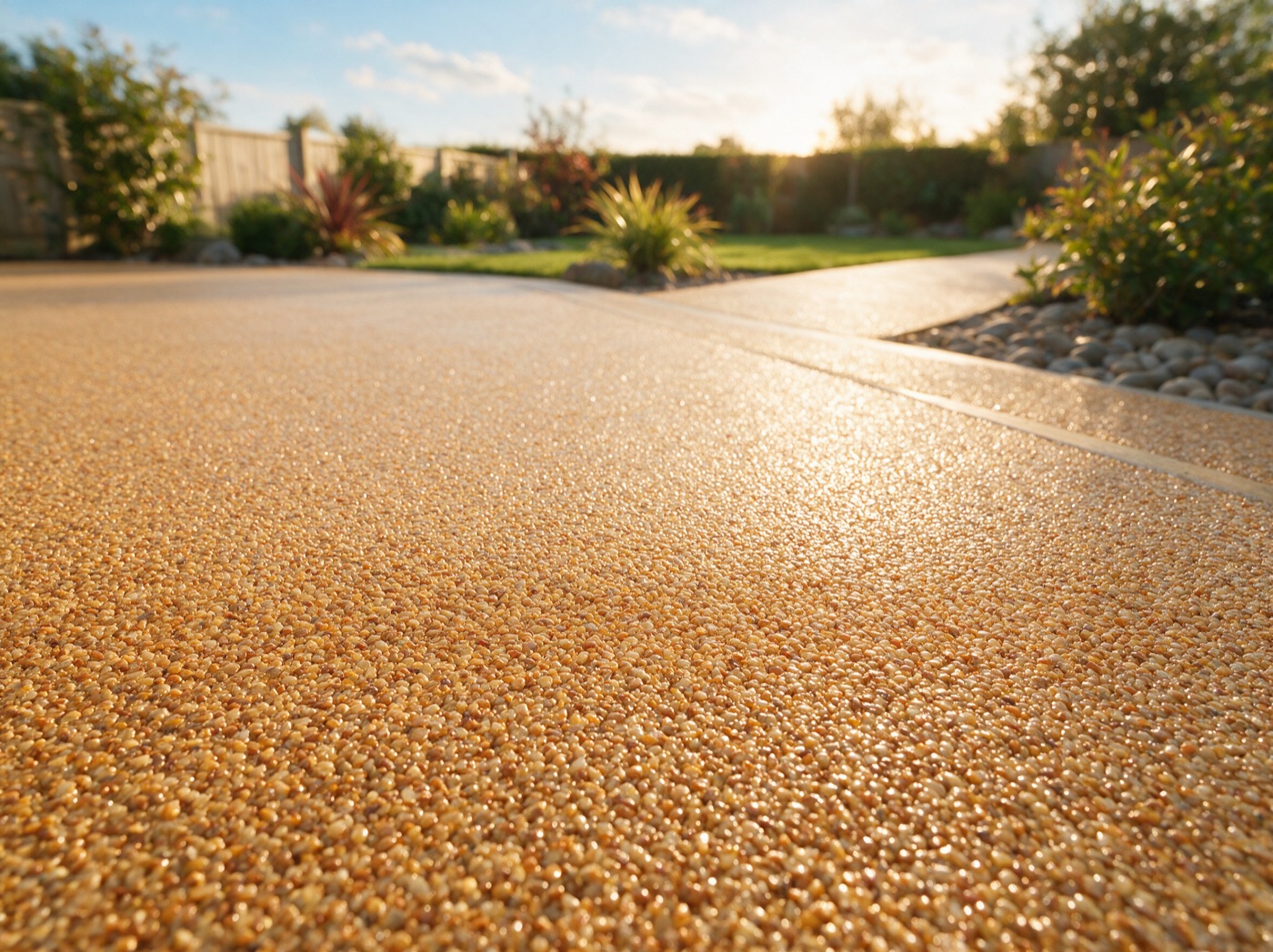

£73–£80 ex VAT per 4m² kit (≈£22–£24/m² inc VAT)
The economical way in: four 25kg bags of blended stone plus a two-part UV-resistant resin, one kit per 4m². The label to insist on is UV-stable — supplier ranges price non-UV resin cheaper, and it darkens unevenly in sunlight, leaving shadow marks under pots and bins. Mixed with a forced-action mixer per the supplier's own spec.
Resin + stone kits at The Resin Mill →DIY kits (paths, patios, repairs): Specialist resin suppliers sell complete stone+resin kits by coverage — a 4m² kit at 15mm runs £73–£80 ex VAT (≈£22–£24/m² inc VAT), and 1m² starter kits about £40. Buy UV-stable ('UVR'/aliphatic) even though it costs more — cheap aromatic resin yellows unevenly within a couple of summers.
The mixer: Small kits mix with a drill and paddle. Anything beyond a few square metres wants a forced-action mixer — hire runs £200+VAT a week with a hefty deposit, which is exactly why whole-drive DIY rarely beats the professional price.
The weather window: Free, and the most important input: resin laid in rain cures cloudy and foamy, permanently. Book a dry day, start early, and keep everyone off it for 24 hours — and cars off for 72.
Paths & patios
 First try / small repairs
Prices checked July 2026 · how we check them · how we work it out
Some links are affiliate links — we may earn a commission, at no cost to you. Retailers named because we checked their prices in July 2026, not because they paid to be here.
Survey & prep: The base decides everything: power-wash, dry, break out and refill any cracks (to 200mm), or dig and build the new base. On an overlay this is a day; on a rebuild it's most of the job.
Edging: Resin needs a hard edge to finish against — existing kerbs, or new edging at £15–£40 per linear metre.
Laying day: The whole surface goes down in one continuous pour — batches mixed in a forced-action mixer, trowelled at pace (a crew covers roughly 20 linear metres an hour), finishing wet edges before they stiffen. Dry weather is non-negotiable: rain mid-cure clouds the finish permanently.
The cure: Foot traffic after ~24 hours, cars after ~72 — driving early pulls aggregate out of the surface. A crew that says otherwise is cutting corners on your drive.
Aftercare: The easy bit: sweep it, hose spills promptly, low-pressure fan-nozzle wash occasionally. Iron-oxide 'rust spots' appearing months later are usually trace minerals in the stone itself, not installer error — specialist removers shift them.
A proper written quote itemises:
Questions that sort pros from cowboys:
Walk away if:
Booking: A typical resin crew (£300–£500 a day for the team) does a 50m² drive in 2–5 days including prep. Good installers book out through the dry months — and 'we can start tomorrow with leftover materials' at your doorstep is the classic driveway scam, not a bargain.
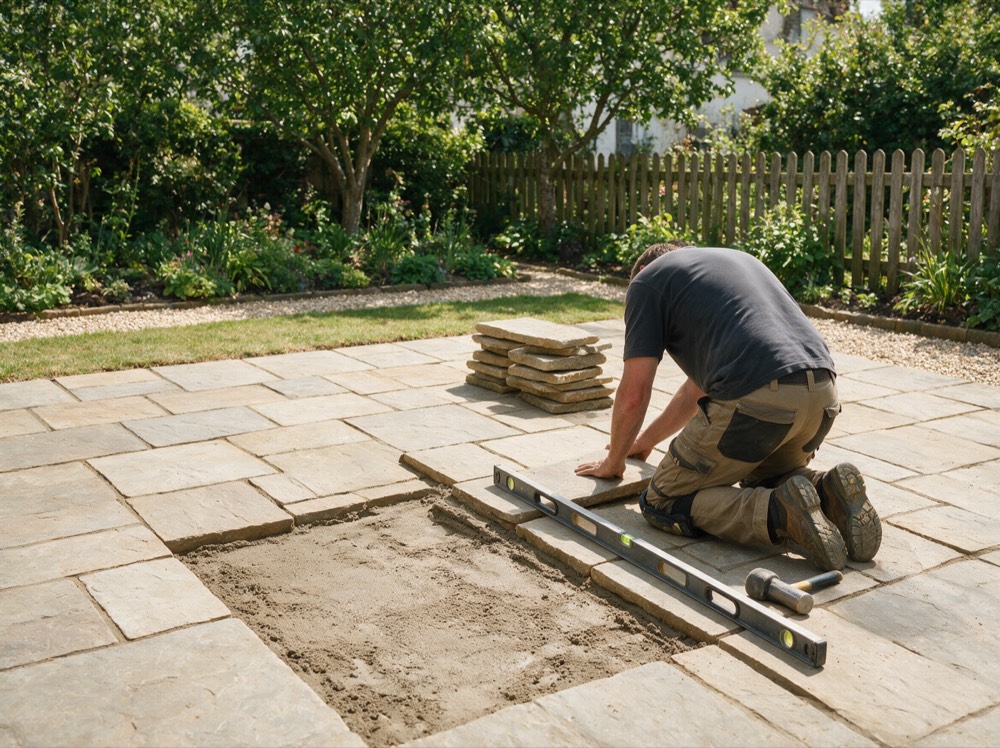
Our figure is researched, but it is not your garden. Post the job free and local landscapers reply with real prices — the honest way to check the estimate above before you commit.
Compare with real quotes →Free to use. If you get quotes through this link we may earn a commission, at no cost to you.
Resin-bound is a driveway surface made by mixing small stones with a clear glue (the resin) and spreading it smooth and flat. It looks seamless, and rain drains straight through it.
Resin-bonded is different: the glue is painted on first, then loose stones are scattered over the top. It looks and feels like gravel, sheds stones, and rain cannot drain through it.
Both get sold as "a resin drive", but bound is the proper long-life product — and either way, the surface is only a thin skin, so what matters most is the base (the hard layer underneath it).
Resin-bound is priced per square metre fitted, because the material and the labour come as one job: a 15–18mm top layer of stone and resin, mixed on site and spread in one continuous pour. Our overlay price (£60–£100/m²) — an overlay means laying resin straight on top of your existing drive — blends the 2026 trade guides (£60–£95) with the prices installers publish themselves (about £80), for work on a solid existing base.
The rebuild price (£120–£160/m²) is the range the manufacturers publish for ripping out the old drive, building a new base that rain can soak through, and laying the resin on top. The gap between the two prices — £25–£50/m² of ground work, plus carting the waste away — is why any honest quote starts by asking about the state of your current drive.
DIY kit maths: a 4m² kit at 15mm depth costs £73–£80 ex VAT (that is, before VAT is added). That puts materials at roughly £22–£24/m² including VAT; small 1m² starter kits cost about £40/m². Doing it yourself looks far cheaper — until the base underneath needs work you can't do yourself.
| Driveway | Overlay (sound base) | Full rebuild |
|---|---|---|
| Single — 15 m² (5 × 3m) | £1,400–£2,400 | £1,800–£2,400 |
| Standard — 30 m² (6 × 5m) | £1,800–£3,000 | £3,600–£4,800 |
| Double — 50 m² (10 × 5m) | £4,000–£6,000 | £6,000–£8,000 |
Prices checked July 2026. Small drives sit at the top of their price band — it costs the crew the same to bring their people and machines out for 15m² as for 50m², so the published prices for a 20m² drive run £1,800–£2,800. The 30m² overlay figure is the range the guides publish; at the £120/m² market average, budget about £3,600.
| Resin-BOUND | Resin-BONDED | |
|---|---|---|
| How it's made | Stone and resin fully mixed, then spread smooth | Resin painted on, stones scattered over the top |
| Feels like | Seamless and smooth, no loose stone | Loose gravel — and stones come off as it wears |
| Lets rain drain through? | Yes — so it skips the 5m² planning rule, if the base drains too* | No — the 5m² planning rule applies |
| Lifespan | 15–25 years | Needs re-doing within 5–8 years |
| Cost | £60–£120/m² | £40–£70/m² |
*This is the rule in England & Wales; Scotland and Northern Ireland differ. Check with your council if unsure.
Both get sold as "a resin drive". If the quote doesn't say bound in writing, assume it isn't — the gap in price is exactly the gap in product.
• The base — sound tarmac already under there saves you £25–£50 per m²; a failed base costs that much again to rebuild. This one thing swings the price more than everything else put together.
• Drive size — bringing the crew and machines out costs the same whatever the size, so a 20m² drive prices at £90–£140/m² while 100m² can drop to £70–£115. Most jobs land around £80.
• The resin itself — UV-stable resin (resin that won't yellow or fade in sunlight) costs roughly twice as much as the cheap kind. It's the corner most often cut, and the one you'll be looking at for 20 years.
• The stones — fancy stone blends add £10–£20/m². They only change the look, not how long the drive lasts.
• Edging and drainage — resin needs a hard border to finish against, and new edging costs £15–£40 per metre of edge. Where the design needs extra drainage, add £300–£1,000.
Over a sound existing base: £60–£100 per m² fitted (the 2026 guides quote £60–£95; installers average about £80) — so £1,800–£3,000 for a 30m² drive. If the old drive has to be dug out and a new rain-draining base built: £120–£160 per m². Small drives cost more per square metre because it costs the same to bring the crew and machines out whatever the size — 20m² jobs tend to land around £1,800–£2,800.
Bound: the stones and resin are fully mixed together, then spread smooth. Rain drains through it, so it meets the SuDS drainage rules (the rules that stop paved front gardens flooding the street), and it lasts 15–25 years — this is the real driveway product. Bonded: the resin is painted onto the base and loose stones are scattered on top. It looks like loose gravel, sheds stones, does NOT let rain through, and needs re-doing within 5–8 years. Bonded quotes (£40–£70/m²) get dressed up as cheap 'resin drives' — make sure your quote says bound.
Yes — it's the best-value route, and perfectly sound practice if the base is in good shape: no cracks, no sinking, power-washed clean and dry. Any damaged patches get cut out to 200mm and refilled first. But remember resin is only a 15mm skin. If the base underneath cracks or moves, those cracks show straight through the new surface (the trade calls this reflective cracking), and no top layer can rescue a bad base. Sound base → lay over it; failing base → rebuild.
This is the England & Wales rule (Scotland and Northern Ireland differ). Resin-bound on a base that rain can soak through: no permission needed at any size — but only if every layer underneath drains too, right down through the sub-base (the layer of packed stone at the bottom). Bound laid over a sealed concrete slab with no drainage does not qualify. Resin-bonded does not let rain through, so if it covers more than 5m² of a front garden the water must drain to a lawn, border or soakaway (a buried pit that lets water soak into the ground) — or you need planning permission. One more reason to get bound-or-bonded in writing.
Cheap resin — the trade calls it aromatic, meaning it isn't UV-stable — darkens in sunlight. It darkens unevenly, so anything sitting on the drive (a bin, a planter, a parked car) leaves a pale shadow behind when you move it. UV-stable resin (the aliphatic kind) costs roughly twice as much, holds its colour, and is less brittle too. Ask for the resin system by name and get 'UV-stable' in writing — it's the single most common corner cut on cheap quotes.
Paths, patios and repairs: genuinely yes — 1m² kits mix with a drill and paddle (~£40/m²), and 4m² kits bring materials down to ~£22–£24/m². Whole driveways: rarely worth it. You'd need to hire a forced-action mixer (the heavy-duty tub mixer resin needs — £200+VAT a week plus a deposit), a guaranteed dry day, and the speed to spread each batch within its 45-minute working time before it stiffens. And if the base isn't already sound, the ground work you can't do yourself is where the professional's money goes anyway.
15–25 years if it's laid properly (the guides split between 15–20 and 21–25 — the quality of the fitting is what decides it). Upkeep is the lightest of any driveway surface: sweep it, mop up spills quickly, and give it an occasional gentle low-pressure wash. Weeds can't root through the bound surface itself; a bit of moss on top in shady corners is the only regular visitor.
Usually not, if you compare building each from scratch — the 2026 comparison tables put resin at the top (£120/m² average) with block paving around £100. Resin wins in one specific case: laying it over an existing sound base, where the overlay at £60–£100/m² beats the cost of digging anything else in. Over its whole life (20+ years, almost no upkeep) resin also pays you back — but slowly.
Every price band on this page traces to a source we checked ourselves, with the date we checked it. Prices move — if one of these looks out of date, tell us and we'll recheck it.
We'll carry this over — your driveway and the size you just worked out — and you can add anything else you're thinking about: clearance, paving, decking, fencing, lawn, driveways, planting. You end up with one brief to send to three landscapers, so they all price the same job and you can see which one has quietly left something out.
Doing it yourselves? It sizes your materials list too. Already holding a quote? It gives you the same numbers we'd check it against.