Enter your shed size (the feet toggle is there for a reason). We'll quantify all three routes — poured concrete, paving slabs and plastic grids — with honest 2026 costs.
Quick answer: A shed base costs anywhere from £57 (plastic grid kit, 6x4 shed, laid yourself) to £1,200+ (concrete, 8x6, laid by a pro) in 2026. A concrete base needs 100mm of C20 concrete (a standard-strength mix) over packed-down MOT Type 1 (crushed stone). For a normal garden shed, a plastic grid kit does the same job for about a tenth of the price of fitted concrete.
Prices checked July 2026 · how we check them · how we work it out
Rough size is fine — pace it out: one stride ≈ 0.9 m.
Your results will appear here.
Some links are affiliate links — we may earn a commission, at no cost to you.
Base = exact shed footprint, never larger (oversized bases splash rain back onto the cladding and rot it). Concrete route assumes 100mm of C20 over 75–100mm compacted MOT Type 1.
Sense-check it: compare these figures with real quotes from local tradespeople — free, no obligation. Already got a quote? We’ll read it against these same price bands — also free.
Prices checked July 2026 · how we check them · how we work it out
These figures are planning estimates. Heavy workshops (machinery, log stores) want 150mm of C25 concrete rather than the standard 100mm C20 — and every route needs firm, level, well-drained ground underneath.
Pick your route — each opens Amazon.
Affiliate links — we may earn a commission, at no cost to you.
Our figure is researched, but it is not your garden. Post the job free and local tradespeople reply with real prices — the honest way to check the estimate above before you commit.
Compare with real quotes →Free to use. If you get quotes through this link we may earn a commission, at no cost to you.
Concrete is a wet mix you pour into a wooden frame and leave to set into one solid slab. Strongest, most work.
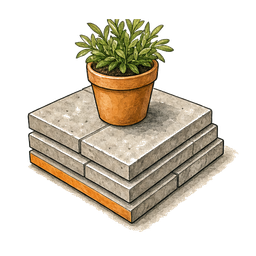
Paving slabs are big flat squares of stone or concrete. You lay them side by side on a bed of sand, like a patio.
Plastic grids are light plastic squares that clip together on the ground. The shed sits on top. Cheapest and quickest by far.
All three do the same job: they give the shed a flat, dry, solid surface so it doesn't sink, lean or rot. Whichever you pick, the ground under it must be firm and level first.
Your base should be exactly the same size as the shed — no bigger. That sounds odd, but a base that sticks out past the walls catches rain and splashes it back up onto the cladding (the shed's outer boards), and that's how sheds rot from the bottom up. From your shed's area we work out all three routes: concrete — 100mm of C20 (a standard-strength mix: 1 part cement to 5 parts ballast, which is a mix of gravel and sand) poured over 75–100mm of packed-down MOT Type 1 (crushed stone that packs hard — the base layer under most paths and patios), with a DPM (a plastic damp-proof sheet) between the two; slabs — 600×600 paving slabs on a bed of sand and cement over the packed stone; and plastic grids — 500×500 grids that clip together on levelled ground, with the weed-stopping membrane included in the kit.
Here's the bit that surprises people: a cubic metre of mixed concrete needs about 2 tonnes of ballast and fourteen 25kg cement bags. Even a modest 8x6 shed is ~0.45m³ — that's over a tonne of material to wheelbarrow through your garden. That's the honest case for grids on ordinary sheds.
Prices checked July 2026 against Wickes, B&Q, shed-base specialists and trade cost guides. Rounded ranges, not quotes.
| Item | Typical range |
|---|---|
| All-in ballast (850kg bulk bag) | £72–£78 |
| Cement (25kg bag) | £7.50–£8.50 |
| MOT Type 1 sub-base (850kg bag) | £50–£80 |
| DPM membrane (4×3m, 1000 gauge) | ~£22 |
| 600×600 paving slab (each) | £10.50–£15.50 |
| Plastic grid base kit (per m², incl. membrane) | £19–£31 |
| Labour (concrete base, per m²) | £40–£50 |
| Shed | Plastic grid (DIY) | Slabs (DIY) | Concrete (DIY) | Concrete (fitted) |
|---|---|---|---|---|
| 6x4 ft (2.2 m²) | £57–£82 | £120–£235 | £185–£230 | £500–£750 |
| 8x6 ft (4.5 m²) | £102–£115 | £180–£320 | £300–£340 | £750–£1,200 |
| 10x8 ft (7.4 m²) | £135–£165 | £330–£560 | £420–£470 | £1,000–£1,500 |
A concrete base laid by a pro often costs more than the shed that goes on it. For a standard garden shed, a grid kit does the same job for a tenth of the money — save concrete for workshops.
• Which route you pick — grid, slab and concrete span a 10× cost range for the same shed.
• What's going in the shed — a workshop with heavy machinery needs 150mm of the stronger C25 mix and a proper stone layer underneath. A mower store doesn't.
• The ground — if it slopes or is soft, you'll dig out more and need more stone underneath, whichever route you choose.
• How you mix — ready-mix lorries (concrete delivered already mixed) usually won't come for less than 2m³ and charge extra for small loads. At shed sizes, mixing bagged materials yourself usually works out cheaper.
• Getting materials in — a tonne of ballast through a side gate takes a morning. Through the house, it takes a day and a lot of dust sheets.
Plastic grid kits, by a long way: £57–£82 for a 6x4 shed, £102–£115 for an 8x6. The membrane (a sheet that stops weeds growing through) comes in the kit, and a standard garden shed doesn't need any gravel fill. They cost a fraction of a concrete base, go down in about an hour on level ground, and you can lift them and reuse them if you ever move the shed.
100mm of C20 concrete over 75–100mm of compacted MOT Type 1 — that's the normal spec for a garden shed. In plain terms: C20 is a standard-strength mix (1 part cement to 5 parts ballast), and MOT Type 1 is crushed stone that packs down hard to make the layer underneath. Go up to 150mm and the stronger C25 mix for heavy workshops or anything with machinery. You can walk on it after 48 hours, but it takes 28 days to reach full strength.
No — make it exactly the same size as the shed, never larger. A base that sticks out past the walls catches rain and splashes it back up onto the cladding (the shed's outer boards). That's how shed walls rot from the bottom up. (Loose gravel pads are the one exception — they extend ~300mm all round.)
If you pay someone to lay it, a concrete base costs about £500–£750 for a 6x4 and £750–£1,200 for an 8x6. Labour runs at £40–£50 per m², and prices swing either way depending on where you live. That's often more than the shed itself — which is why the plastic grid route is worth an honest look for standard garden sheds.
Concrete is the base for life: dead flat, takes any weight, but the most work and the most money. Slabs sit in the middle — solid, doable yourself in a day, and easy to lift and adjust later. Plastic grids are the sensible winner for standard sheds: cheapest, quickest, rain drains straight through, and kinder to the garden. Match the base to the building: workshop → concrete; ordinary shed → grids or slabs.
Yes — a 1000-gauge polythene DPM (a thick plastic damp-proof sheet, about £22 for a 4×3m piece) goes between the packed stone and the concrete. It does two jobs: it stops damp rising from the ground up into your shed floor, and it stops the wet concrete losing its water too fast into the stone below, which would weaken it.
Every price band on this page traces to a source we checked ourselves, with the date we checked it. Prices move — if one of these looks out of date, tell us and we'll recheck it.